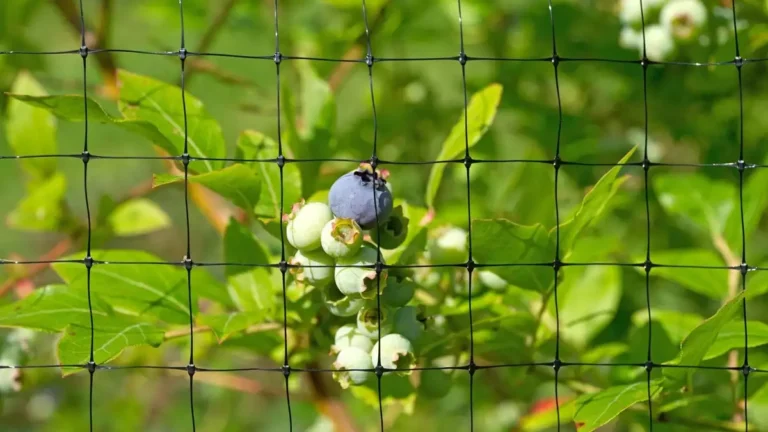
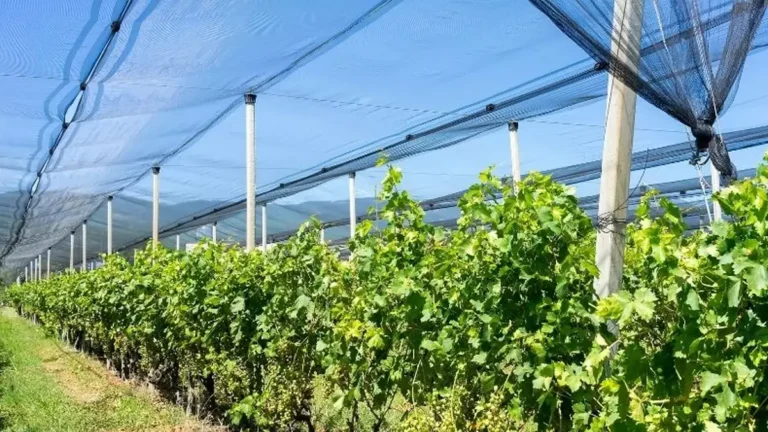
Professional-grade agricultural netting is no longer an optional expense; it is a high-ROI "climate insurance" that prevents up to 100% crop loss from hail and boosts marketable yields by up to 25% through precision microclimate control.
Professional-grade agricultural netting is no longer an optional expense; it is a high-ROI “climate insurance” that prevents up to 100% crop loss from hail and boosts marketable yields by up to 25% through precision microclimate control.
At HONREL AGRICULTURE, we have spent years as a leading Agricultural Netting Manufacturer, helping commercial farms and wholesale distributors transition from “survival mode” to “optimized production.” In this guide, we’re sharing our expert experience on why the right netting is the backbone of modern profitable farming.
Table of Contents
1. Why Agricultural Netting is “Climate Insurance”
One ten-minute hail storm can wipe out an entire season of work. For commercial orchards and vineyards, the risk is too high to leave to chance.
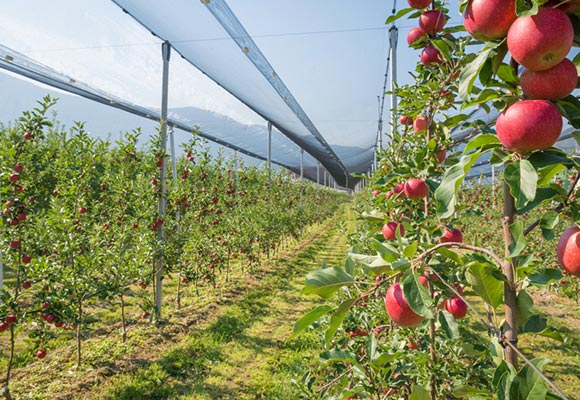
When we talk to growers, we focus on the 98% salvage rate. Data from recent commercial harvest reports shows that orchards protected by professional 60-70 GSM hail netting survived storms that caused 100% loss in neighboring unprotected fields (Source: Fruit Growers News Research).
Beyond the catastrophic events, Agricultural Netting provides daily value. By reducing leaf temperatures by 4°C to 8°C, these nets prevent plants from “shutting down” during peak summer heat. This keeps photosynthesis running at 100%, leading to larger fruit and higher sugar content.
A common mistake we see is growers thinking “any shade is good shade.” That’s not how it works. Different crops have different light hunger.
At HONREL AGRICULTURE, we specialize as a Shade Net Manufacturer that offers customized shade coefficients from 30% to 90%.
Choosing the Right Shade Percentage
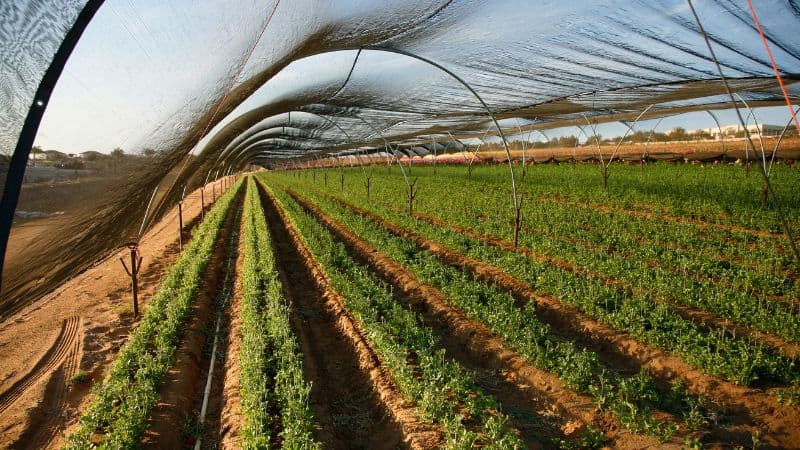
30% – 50% Shade: Ideal for vegetables like tomatoes and peppers. It drops the heat while keeping PAR (Photosynthetically Active Radiation) high enough for fast growth.
70% – 90% Shade: Primarily used for ornamental plants, nurseries, or people-cooling areas in farm zones.
The Science of Color
We often get asked if color matters. It does.
Black Nets: These are the industry standard for durability. They absorb solar radiation and are excellent for exterior cooling.
White/Transparent Nets: These reflect light and keep the light levels inside a greenhouse high while still dropping the temperature.
Aluminet (Reflective): These act like a mirror, bouncing infrared radiation away from the crop. This is the “luxury” option for high-value nurseries.
The Evapotranspiration RuleWhen you install shade netting, you aren’t just blocking light; you are slowing down wind speed. This reduces the rate at which your plants lose water (evapotranspiration). In our experience, farms using professional shade mesh can reduce their irrigation needs by up to 15-20% because the soil stays moist longer.
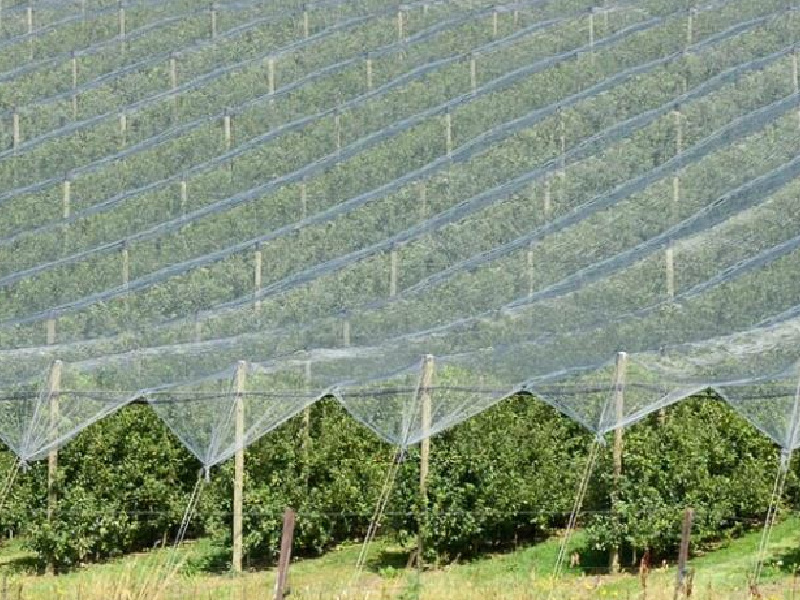
Hail netting isn’t just about “catching ice.” It’s about energy dissipation. When a hailstone hits a net at 100km/h, the net must stretch slightly to absorb the impact without tearing.
As a Hail Netting Manufacturer, we focus on the “Raschel” knitting technique. Unlike woven nets, Raschel knitted nets use a “lock-stitch” pattern. If a bird or a branch punctures a hole in the net, the lock-stitch ensures the hole does not run or unravel, even under high wind tension.
Technical Comparison of Agricultural Nets
Net Type
Primary Material
Standard GSM
Shade % Range
Expected Lifespan
Monofilament Hail Net
100% Virgin HDPE
45 – 75g
10% – 18%
8 – 10 Years
Raschel Shade Net
HDPE + UV Tape
80 – 220g
30% – 95%
5 – 7 Years
Insect/Anti-Thrip
Fine Mesh Mono
100 – 130g
15% – 25%
3 – 5 Years
Bird Exclusion
Lightweight Mono
25 – 35g
< 5%
5+ Seasons
4. Technical Sourcing: What to Ask Your Manufacturer
If you are a B2B buyer looking for Agricultural Netting Wholesale deals, you need to look past the price-per-square-meter. You need to look at the KLY Rating.
The KLY (Kilolangley) Factor
UV radiation is measured in Kilolangleys. A net designed for a low-UV area like Northern Europe (80 KLY/year) will disintegrate in less than two years in high-UV areas like Australia, Arizona, or the Middle East (180+ KLY/year).
Best Practice #2: The UV Optimization Rule Never buy a “standard” UV net if you are in a high-exposure zone. Always ask the manufacturer for the specific KLY rating and the percentage of HALS (Hindered Amine Light Stabilizers). For high-UV areas, we recommend a minimum 5-year warranty with a stabilizer package designed for 700-800 KLY of cumulative exposure.
Virgin HDPE vs. Recycled Plastic
This is the “dirty secret” of cheap wholesale netting. Recycled plastic has weakened polymer chains that break down almost immediately under the sun. For any net meant to last more than one season, 100% Virgin HDPE is a non-negotiable requirement. Recycled materials simply cannot handle the structural stress of hail and wind (Source: Plastics Industry Association).
5. Installation and Longevity Best Practices
We have seen expensive, high-quality netting fail not because of the material, but because of poor installation.
Tensioning and Reinforced Edges
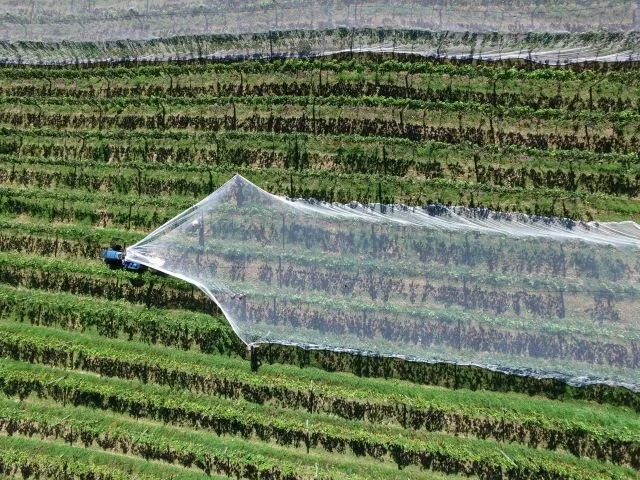
A sagging net is a dangerous net. When wind gets under a loose net, it creates a “parachute effect,” putting massive stress on your support poles. We manufacture our nets with reinforced selvedges (edges) that allow for high-tension cable systems.
Expert Tip: Always leave a 5-10cm “stretch margin” when calculating your dimensions. HDPE expands and contracts slightly with temperature changes.
Off-Season Maintenance
If you are in a region with heavy snow, your hail nets must be retractable or “bundled.” Snow load is much heavier than hail. Many growers we work with use a “winter bundling” system where the nets are rolled and tied to the trellis wires during the dormant season. This easily doubles the lifespan of the mesh.
6. Why Wholesale Buyers Partner with HONREL AGRICULTURE
When you are sourcing in bulk, you need a partner that understands the supply chain. We don’t just provide “rolls of holes”; we provide a customized protection system.
OEM/ODM Capacity: We can customize widths, lengths, and even the “denier” (thickness) of the yarn to match your specific crop needs.
Global Logistics: Whether you need a 20ft container for a trial or a 40HQ for a regional distribution network, our logistics team ensures the GSM and UV certifications match the destination’s legal and climate requirements.
Integrated Solutions: Many of our B2B clients find success by pairing our netting with HONREL AGRICULTURE greenhouse films and mulch films, creating a total climate-controlled environment.
FAQ: Frequently Asked Questions from Wholesale Buyers
Q: What is the typical MOQ for custom wholesale netting?
A: For custom widths or specific GSM (weight) requirements, we usually require a minimum order of 2,000 to 5,000 square meters. This allows us to set up the Raschel knitting machines for a dedicated production run.
Q: Can shade nets protect against insects?
A: Standard shade nets are too open to stop small insects like thrips or aphids. For that, you need a dedicated “Anti-Insect Mesh” with a 40-mesh or 50-mesh count. However, shade nets do act as a physical barrier for larger pests like birds and beetles.
Q: Why choose Black over White shade nets?
A: Black nets are naturally more UV-stable because the carbon black additive is a superior UV inhibitor. They are better for long-term exterior use. White is better for interior use or for crops that need “cooler” shade without losing as much PAR light.
Q: How do I know if the netting is 100% Virgin HDPE?
A: Virgin HDPE has a slight “translucence” and a smoother feel. Recycled netting often feels “waxy,” has a duller color, and frequently has a chemical odor. Always ask for a material certificate (COA) from your supplier.
Q: Does hail netting interfere with pollination?
A: No. Our monofilament hail nets have a wide enough mesh (usually 7mm x 3mm or similar) to allow bees and other beneficial insects to pass through freely while stopping even small hailstones.
Summary: Protecting Your Farm’s Future
Agricultural netting is the ultimate insurance for the modern farmer. Whether you are dealing with the scorching sun of the desert or the sudden hail storms of the mountains, the right mesh ensures that your hard work actually makes it to market.
At HONREL AGRICULTURE, we are committed to manufacturing the highest-quality Agricultural Netting solutions that stand the test of time. Don’t wait for the next storm to realize you needed protection.
Get Factory-Direct Insights & Growing Tips
Selecting the right Greenhouse Film or shade mesh is critical for crop success. As a dedicated Agricultural Netting and Film Manufacturer, our experts help you customize UV protection and light transmission based on your local climate. Share your project details for a tailored solution.
HONREL AGRICULTURE engineers films, netting, and drip pipe to your crop, climate, and structure—specs, colors, labeling, and packaging—backed by drawings and spec sheets.
Fast Response & Quick Proofing
Rapid quoting, spec-sheet/sample proofing, and practical engineering support. We align specifications and documentation quickly to keep your project timeline on track.
Consistent Quality & Traceability
UV-stabilized formulations, process QC, and lab checks for optics/mechanics—plus lot-level tracking. COA/test reports available; export packing and labeling are standardized.