Custom Anti-Bird Net Manufacturer for Commercial Warehouses: Preventing Nesting and Product Contamination
In practice that means netting the roof void above the racking, the canopy over the loading docks, and any ledges or beams where birds perch or nest, using a mesh small enough for the species you have, fixed tight on a proper cable frame.
Most warehouse bird problems are solved by the same idea: close off the spaces birds use, rather than trying to scare them away. In practice that means netting the roof void above the racking, the canopy over the loading docks, and any ledges or beams where birds perch or nest, using a mesh small enough for the species you have, fixed tight on a proper cable frame. Done well, it takes birds out of the building’s upper spaces without changing how the floor works.
What follows is roughly how we’d walk a facility manager through it, from the first look up at the roof to the order.
Table of Contents
Why Are Birds a Contamination and Maintenance Problem in Commercial Warehouses?
Bird Droppings, Nesting Materials and Product Exposure
Walk into the middle of any warehouse dealing with a bird infestation and look straight up. You’ll spot the mess on the steel trusses and purlins first—whitewash streaks running right down the beams and old nesting junk jammed tight into every joint and gusset plate. Look down and you’ll find the same droppings on the top of racking, on pallets, on shrink-wrapped goods and on the floor along the aisles.
For a general goods warehouse that’s a cleaning bill and a lot of damaged packaging. For anything holding food or food packaging it’s more serious. US food safety rules state plainly that “pests must not be allowed in any area of a food plant” and that effective measures must be taken to exclude them from processing, packing and holding areas (21 CFR 117.35). Auditors notice birds.
There’s a worker safety side too. According to CDC and NIOSH, you catch histoplasmosis straight up by breathing in fungal spores—and one of the quickest ways workers get hit is by shoveling out heavy piles of bird or bat poop from old buildings. Dealing with a major mess like that takes some serious protection. Honestly, it’s just one more huge reason to keep pests out and stop the buildup before it gets out of hand.
Common Entry Points Around Loading Bays and Roof Structures
Birds mostly come in through openings that stay open for long stretches. Dock doors are the obvious one, especially on busy sites where they’re up most of the day. After that come gaps at the eaves, open ridge vents, broken roof panels, and the canopy over the docks, which is often just as attractive to birds as the building itself because it’s sheltered and full of ledges.
Where Should Anti-Bird Netting Be Installed in a Warehouse?
Roof Beams, Rafters and Ceiling Voids
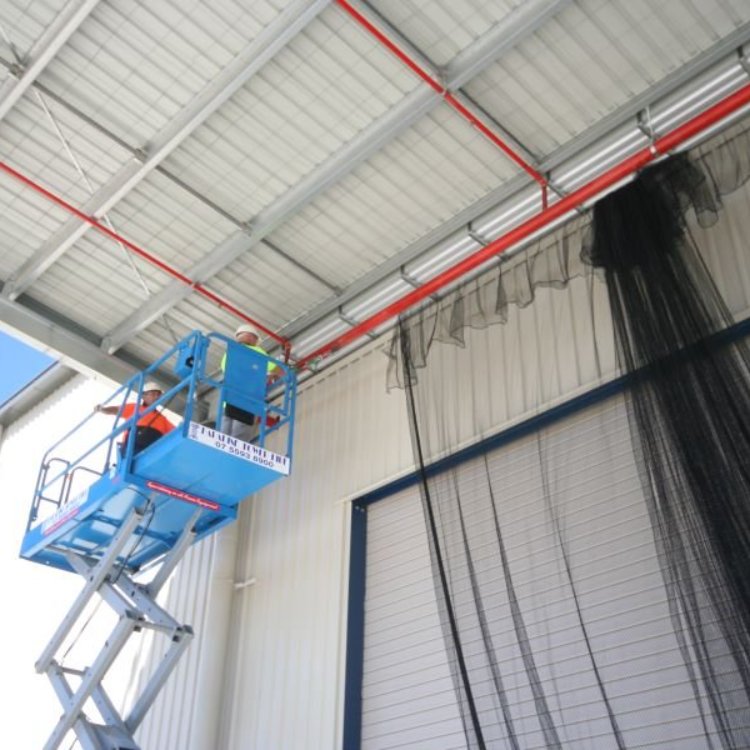
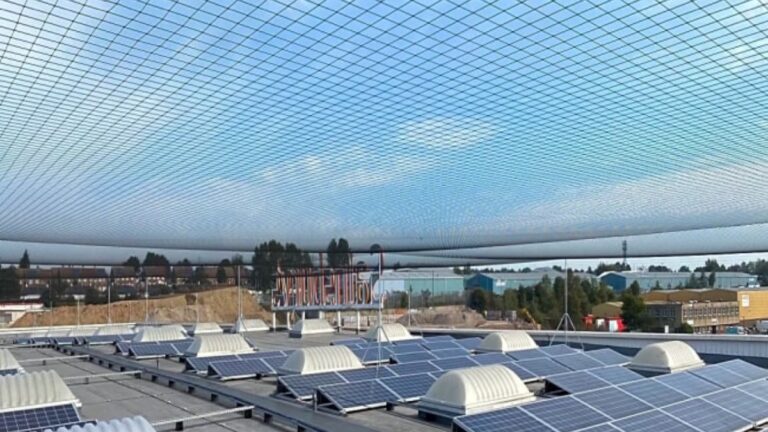
In most warehouses the main job is to net off the roof void: a net hung below the roof structure, usually at the level of the bottom chord of the trusses or just under it, so birds can no longer reach the beams they perch and nest on. Lights, sprinklers, cable trays and ducts all have to be worked around, and that’s usually where most of the planning time goes. Done properly, the void above the net becomes dead space to birds.
Loading Docks, Openings and Storage Areas
Dock canopies are often netted on their own, as a separate panel under the canopy structure. Where trucks and forklifts pass below, the net needs to sit high enough not to be hit and to be fixed well enough not to sag. For the doors themselves, netting alone won’t do it. Fast-acting doors or strip curtains do more there, and they work best alongside netting overhead.
Smaller ledges, signs and pipe runs outside the building often get their own pieces of netting or other deterrents, so birds don’t simply move a few meters along the wall. The UC IPM page on nesting birds makes the same point: birds often shift to areas that aren’t covered.
How to Choose Bird Netting Mesh Size, Material and Durability
The mesh has to be small enough that the target bird can’t get through. You don’t need fine mesh for pigeons like you do for sparrows or starlings—they’re big enough that you can get away with a much wider gauge. So rule number one is figuring out what pests you’re actually dealing with. Suppliers usually stock around 50 mm for pigeons and drop down to about 19 mm for small birds, but always double-check the mesh size against whatever’s flying around your facility.
Bird problem
Mesh to ask about
Note
Pigeons only
Larger mesh, commonly around 50 mm
Lighter, less visible, cheaper per square meter
Sparrows, starlings or mixed
Smaller mesh, commonly around 19 mm
Stops small birds, but heavier and more noticeable
Not sure
Identify the birds first
Choose for the smallest bird that’s causing trouble
For material, polyethylene or nylon netting with UV stabilization is normal. Inside the roof void, UV exposure is modest, but near skylights and under open canopies it matters more. Fire-rated netting may also be required by the building owner or insurer, so ask early.
What Should Buyers Consider When Designing Custom Warehouse Bird Netting?
Irregular Structures, Obstacles and Custom Panel Dimensions
Very few warehouses are a clean rectangle once you look at the roof. Columns, roof lights, sprinkler heads, fans and cable runs all break up the space. Before anything gets ordered, someone needs to measure each bay and note every obstacle the net has to pass around. Panels can then be made to size, which saves a lot of cutting and joining in the air.
Fixing Systems, Access Points and Maintenance Clearance
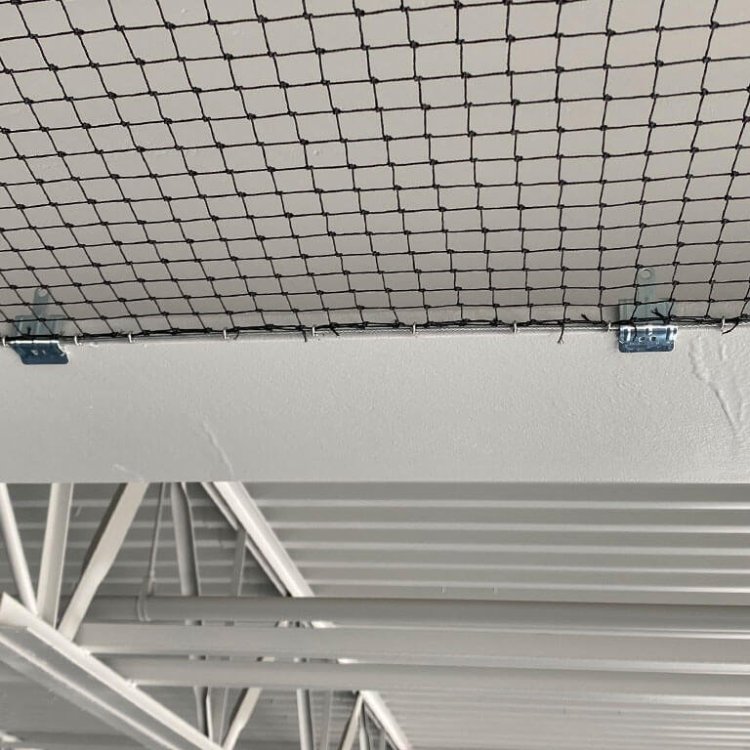
Netting is only as good as what holds it. The usual approach is a tensioned perimeter cable fixed to the structure, with the net attached to it along every edge, so there are no gaps for birds to slip through. Leave access points, usually zips or overlapping flaps, where maintenance teams need to reach lights, sprinklers or roof equipment. Without them, people cut the net to get through and don’t repair it.
How Can Warehouse Netting Be Installed Without Interfering With Daily Operations?
Since crews are working off lifts up above the floor, the big headache is figuring out how to keep operations running without shutting the whole place down. Most guys do it bay by bay, roping off one aisle at a time, or they come in during nights and weekends.
Before anyone touches a tool, you’ve got to lock down the game plan: map out which zones get shut down when, figure out how you’re going to cover and protect the stock sitting underneath from falling crap, and set who actually signs off on each section once it’s done. Oh, and make sure you clean the beams before the net goes up—following proper safety protocols for handling bird droppings—so you don’t just trap a bunch of old filth and mess behind the netting.
How to Maintain Bird Netting and Prevent Birds From Becoming Trapped
A bird net that sags or has loose pockets can trap birds, which is unpleasant and something staff and auditors notice. UC IPM advises keeping netting taut and avoiding loose pockets or wrinkles. Check the net regularly, especially after any work near it, and fix tears and loose edges quickly. If a bird does get trapped above or inside the net, have a simple way to release it.
Some birds are protected by law, and nests may not be removable at certain times of year. Check local wildlife rules before removing nests or starting work.
What Should Facility Managers Confirm Before Ordering Custom Anti-Bird Netting?
Measurements, Material Requirements and Applicable Building Safety Rules
Before you order, have a measured plan of each area to be netted, with heights and obstacles marked. Know which birds you’re dealing with, since that decides the mesh. Confirm whether the building owner, insurer or local rules require fire-rated material, and whether anything will be fixed to the structure that needs approval.
Samples, Quality Control and Bulk Delivery
Ask for a sample of the exact net you’ll receive and check the mesh size, knot or weave, and edge finish. For larger projects, agree how panels will be labeled so installers know which piece goes where, and how they’ll be packed so they arrive clean and untangled.
We make anti-bird netting in different mesh sizes and can cut aƒnti-bird net panels to your measurements. Our wider agricultural netting range and custom manufacturing cover other sizes and private labeling. send us your bay sizes and the birds you’re dealing with, and we’ll recommend a mesh and quote panels.
FAQ
Q1: What mesh size do I need for a warehouse?
A: It depends on the bird. Pigeons can be kept out with a larger mesh than sparrows or starlings. Identify the species first, then choose the mesh that stops the smallest bird causing problems.
Q2: Can netting be installed while the warehouse is running?
A: Usually yes. Installers typically work bay by bay or outside working hours, with the area below closed off while they work.
Q3: Will birds get trapped in the net?
A: They can if the net sags or has gaps. Keep it taut, sealed at the edges, and inspect it regularly.
Q4: Is cleaning up old droppings dangerous?
A: It can be. CDC/NIOSH lists disturbing large accumulations of bird droppings as a risk for histoplasmosis. Follow safe cleaning practice or use a specialist.
Get Factory-Direct Insights & Growing Tips
Selecting the right Greenhouse Film or shade mesh is critical for crop success. As a dedicated Agricultural Netting and Film Manufacturer, our experts help you customize UV protection and light transmission based on your local climate. Share your project details for a tailored solution.
HONREL AGRICULTURE engineers films, netting, and drip pipe to your crop, climate, and structure—specs, colors, labeling, and packaging—backed by drawings and spec sheets.
Fast Response & Quick Proofing
Rapid quoting, spec-sheet/sample proofing, and practical engineering support. We align specifications and documentation quickly to keep your project timeline on track.
Consistent Quality & Traceability
UV-stabilized formulations, process QC, and lab checks for optics/mechanics—plus lot-level tracking. COA/test reports available; export packing and labeling are standardized.